
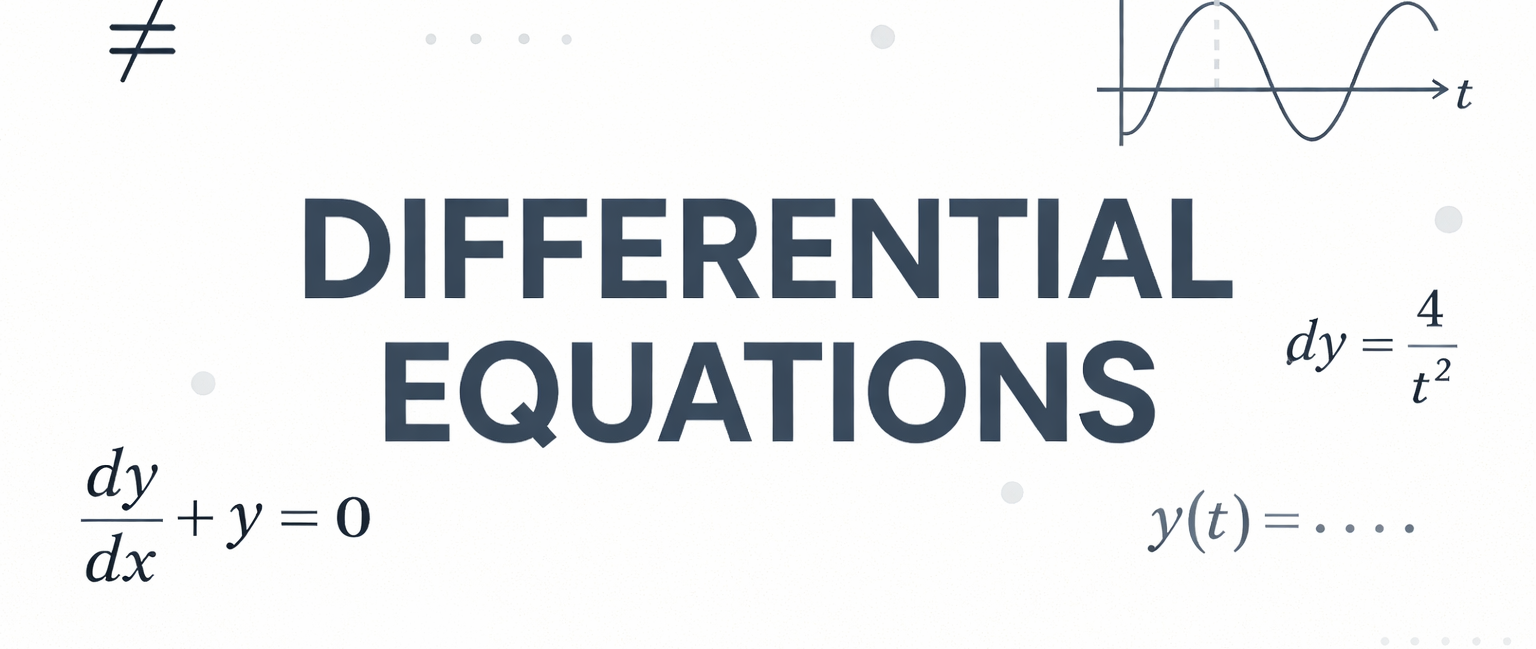

- Differential equations are equations containing derivatives, e.g.
In this class, we would only care about the first two equations, where the third one contains more than one independent variable. All of these kinds of equations are named ODE (Ordinary Differential Equations).
- The order of a differential equation is given by the order of the highest derivative in the equation.
- We say an n-th order differential equation is linear if it can be written as
Practice
| ODE | Order | Linear/Nonlinear |
|---|
Separable ODE
Separable ODE can be written as
and then take the integral for both sides. (This is only for first-order ODE, can be either linear or nonlinear.)
Integrating factors
A technique used to solve the 1st order linear ODE of the form
(Only for first-order linear ODE)
Notation
| Lagrange | Order | Newton | Leibniz |
|---|---|---|---|
| 1-st | |||
| 2-nd | |||
| 3-rd | |||
| 4-th | |||
| n-th |